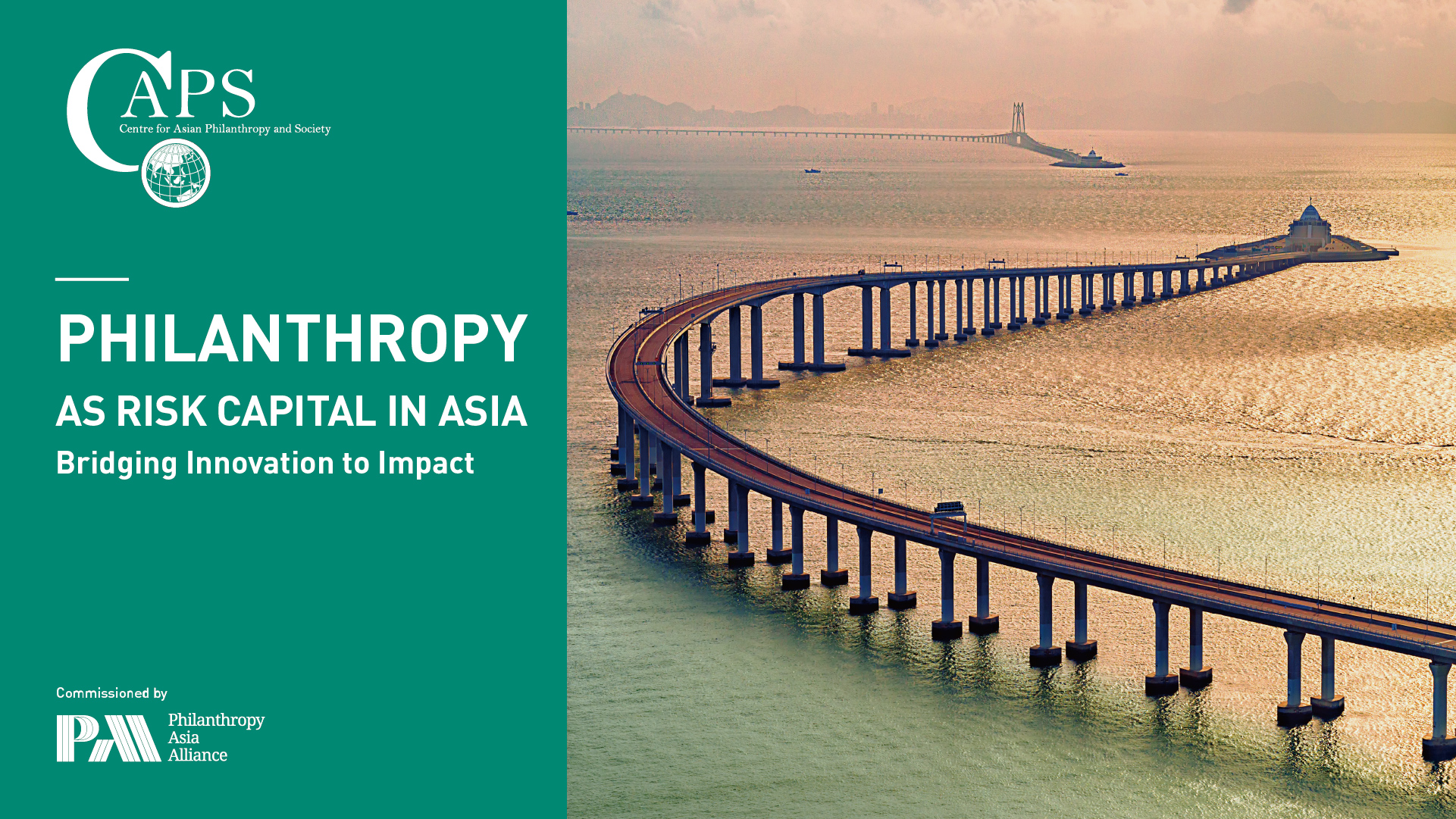
The earliest stages of social innovation in Asia carry the highest risk and the thinnest funding. Governments tend not to back what has not yet been proven, markets will not underwrite returns they cannot see, and conventional philanthropy gravitates to organisations with established track records. A small number of Asian philanthropists are stepping into that gap deliberately, deploying capital where uncertainty is highest and where conviction has to do the work.
A 2026 study by the Centre for Asian Philanthropy and Society (CAPS) found that 81 per cent of social delivery organisations across 17 Asian economies cite securing unrestricted funding as a challenge, a signal of how risk-averse the regional capital pool still is. A new piece of research from the Philanthropy Asia Alliance, conducted by the same team, examines what happens when funders deploy capital into the unproven anyway. Drawing on 37 in-depth interviews and ten case studies across 13 Asian economies, the work identifies a quiet pattern that has so far benefited more than 210 million people.
Conviction-led capital with staying power
How Asian funders manage risk in unproven ventures
Where these philanthropists limit their exposure, they do so through relationships rather than financial modelling. Some have built credibility with government over decades, which lets them position untested approaches inside the public systems that would carry them to scale. Others draw on community trust to the point where new ideas can be tested without the friction strangers face, an advantage the Tahija Foundation called on when seeking household participation in the Yogyakarta trial. Across the cases, the people deploying the money describe a danger that conventional financiers rarely name, the cost of standing still while a problem deepens. In communities where the funders are themselves embedded, that calculus reshapes what counts as prudence.
Where government adoption opens the path to scale
The cases that achieved the broadest reach did so by integrating early with state systems. Wadhwani AI's solutions, embedded into Indian public services through partnerships with government agencies, have benefited more than 190 million people. The Yogyakarta dengue control method, integrated into Indonesia's national health plan after the trial succeeded, now protects approximately 14 million people from a disease that affects an estimated 100 million across the region annually. Urban Spring's water dispensers in Hong Kong schools preceded a wider municipal procurement, with the Environment and Ecology Bureau managing a public tender for the Hong Kong SAR Government. Where philanthropic capital establishes proof of concept and the funder helps the innovator find traction within institutional terrain, government systems can absorb solutions at a scale no single funder could otherwise reach.
Beyond grants, into hybrid instruments
The research suggests this approach is gaining ground beyond the cases studied. Asian philanthropists are moving past traditional grants toward concessional debt and equity instruments designed for the hybrid risk profiles of social innovators. Two barriers slow this further. Some are still uncomfortable with philanthropic money generating financial returns, even where the returns recycle into mission. Regulation around the social sector also restricts the use of certain instruments in some markets, leaving promising organisations stranded between conventional philanthropy and commercial markets. Easing those constraints, with appropriate safeguards, would let funders sequence different forms of support across an organisation's life cycle, building a more responsive ecosystem for the kind of innovation Asia's challenges demand.


.tmb-.png?Culture=en&sfvrsn=4c9d7897_1)
.tmb-.png?Culture=en&sfvrsn=efaef866_1)