
A new chapter for sustainable fashion
As one of the world’s most resource-intensive industries, fashion faces mounting pressure to reinvent itself. With Asia as both a major producer and consumer, circularity offers a powerful path to cut waste, lower emissions, and drive sustainable growth through new materials, low-impact technologies, and innovative production models.
The Amplifier 2025 — a global mentorship programme by the Philanthropy Asia Alliance (PAA) and the Centre for Impact Investing and Practices (CIIP) — is helping impact innovators lead this transformation across global textile supply chains.
Backed by over 70 partners, the programme takes a whole-of-ecosystem approach to help high-potential, impact-driven businesses scale solutions that advance Asia’s sustainable development. Each mentee benefits from deep mentorship, market insights, and catalytic capital supported by organisations across the region.
In its 2025 edition, the Amplifier spans three thematic tracks — Innovation and Circularity in the Textile Value Chain, Sustainability Transformation for SME Suppliers in Tourism, and Unlocking Opportunities and Breaking Down Barriers to Employment — each addressing systemic challenges through innovation, collaboration, and capital mobilisation.
Through its Innovation and Circularity in the Textile Value Chain track, four mentees — Baytech, Haelixa, Novoloop, and Unspun — are tackling waste, improving transparency, and driving circularity across global supply chains. Together, they represent a new wave of innovators redefining how the world makes and remakes what we wear.
Baytech (Turkey): Reinventing denim with less impact
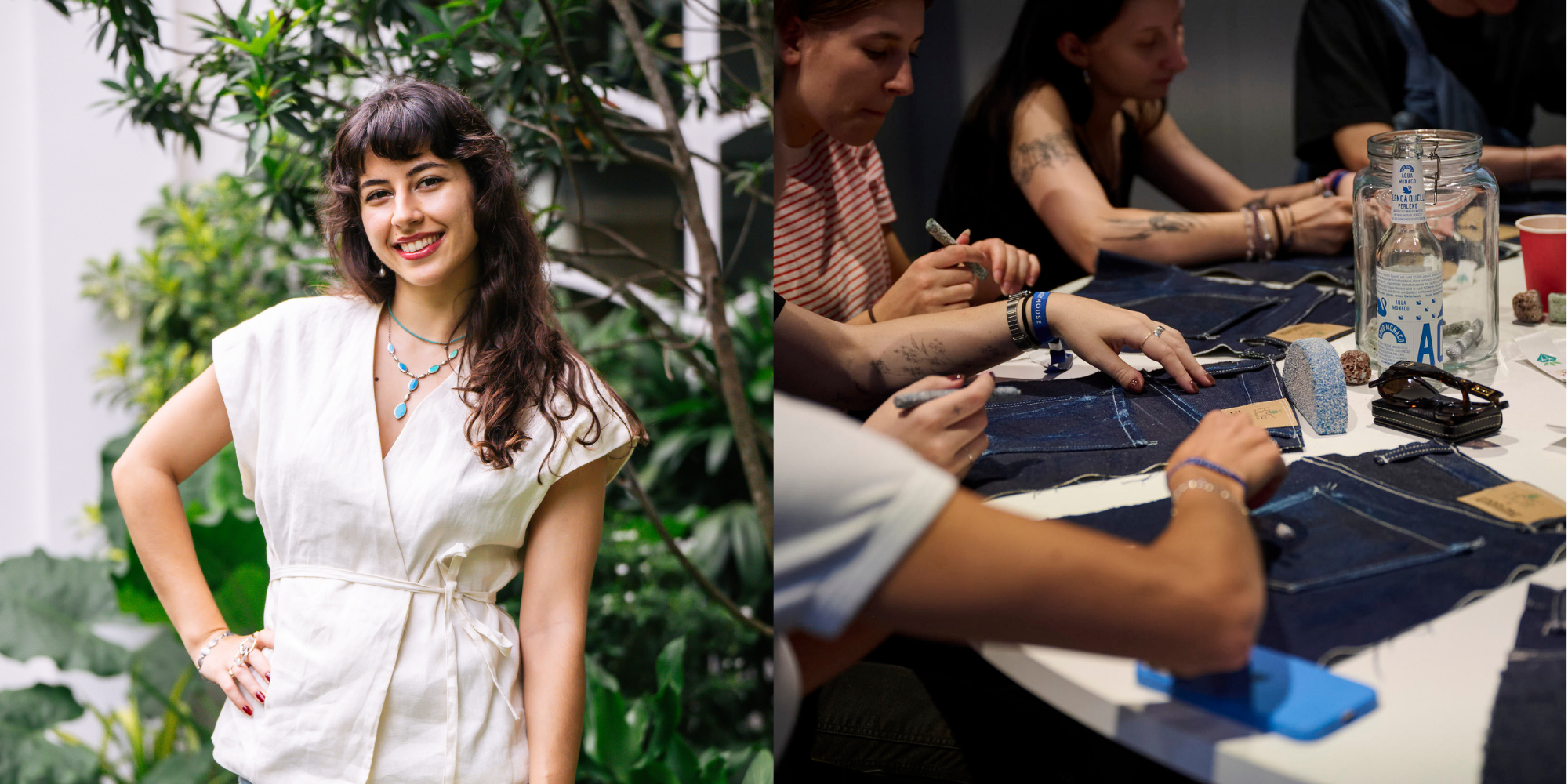
Beyza Baykan, Founder, and Baytech’s HMS stone in use at a denim facility.
Traditional jeans go through a stonewashing process that relies on pumice — a finite resource that generates millions of tonnes of toxic sludge each year. Baytech’s patented Hand Made Stone (HMS) is a sustainable alternative that incorporates upcycled pumice, eliminating sludge and reducing water consumption by a third while achieving the same finish. Drawing on her father’s 30 years of industry experience, founder Beyza Baykan has turned a local innovation into a global sustainability solution.
“What we’re doing is creating a sustainable, more durable alternative that gives the same aesthetic result but doesn’t create any sludge,” said Baykan.
By working directly with distributors, Baytech bridges the gap between innovation and adoption, helping make sustainable production the norm rather than the exception. Through participation in the Amplifier programme, Baytech aims to deepen collaborations across Asia, navigate local regulations, and expand industry education on responsible manufacturing.
Haelixa (Switzerland): Tracing truth in every thread
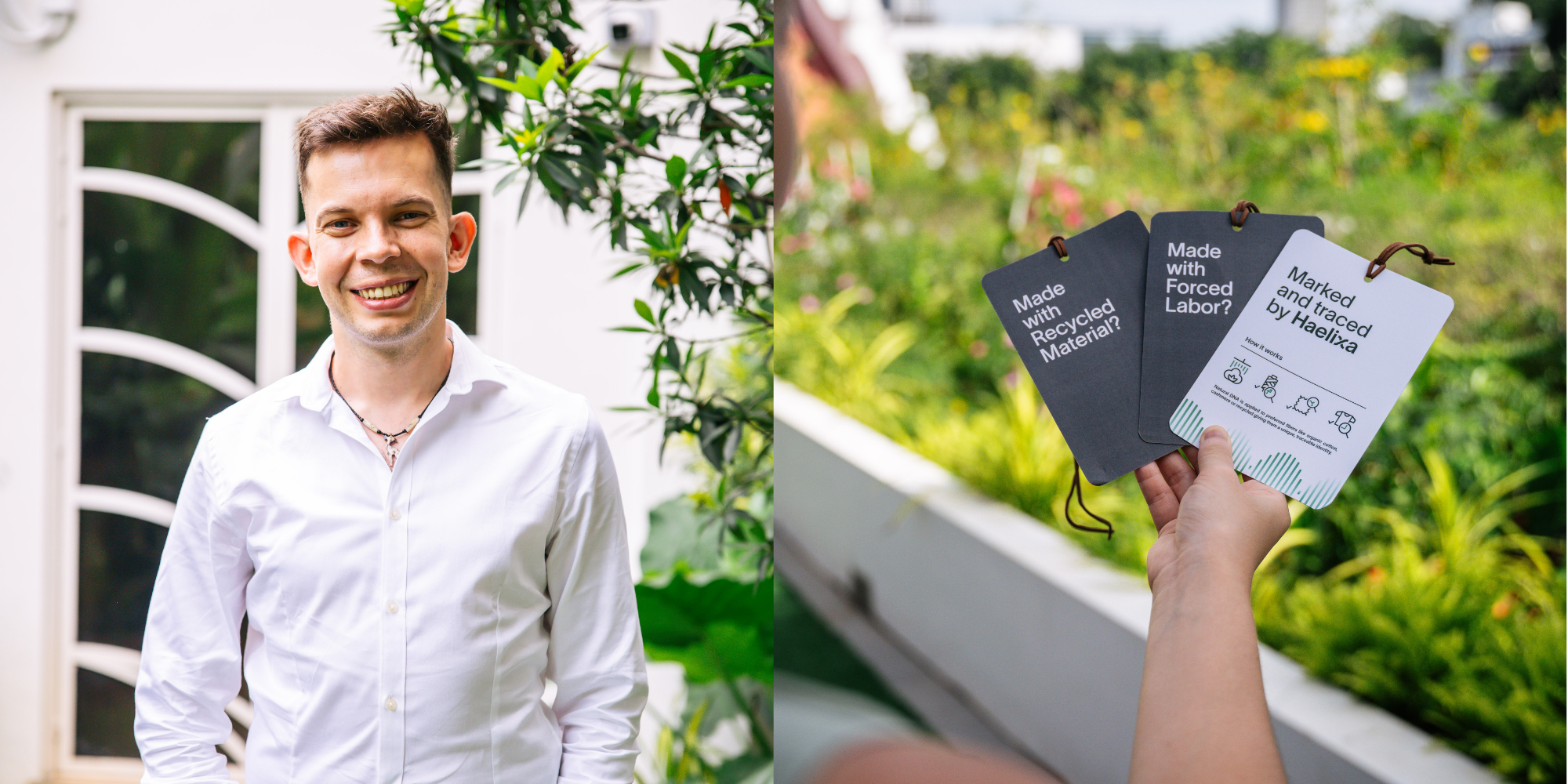
Gediminas Mikutis, CEO, and Haelixa’s traceability label.
In a global supply chain that spans continents, knowing where a material truly comes from can be difficult. Swiss startup Haelixa, co-founded by Gediminas Mikutis, is using DNA-based markers to bring unprecedented transparency to the textile industry.
“Textile supply chains are very complex,” said Mikutis. “Brands often don’t know where the materials they buy come from, and that exposes them to reputational and counterfeit risk.”
By embedding traceable DNA directly into fibres and materials, Haelixa enables brands and manufacturers to forensically verify product origins, prevent greenwashing, and build consumer trust. A simple laboratory test of the final garment can confirm, for instance, whether its cotton truly comes from South India or if its cashmere was sourced from Mongolia.
Haelixa’s solution has already been scaled successfully to 60 million garments across Europe and Asia — a promising sign for traceability in fashion.
The challenge of implementing traceability at scale is coordination across the whole supply chain, from fibre producers and garment makers to brands and retailers. Joining the Amplifier programme will help Haelixa refine its market strategy in Southeast Asia and work with mentors to design a model that makes traceability more accessible for manufacturers and brands alike.
Novoloop (United States): Turning hard-to-recycle plastic into new materials

Jeanny Yao, Co-Founder, and Novoloop's Lifecycled™ TPU material featured on the outsole of On's Cloudprime running shoe.
What if plastic waste could be transformed into usable materials? Novoloop, co-founded by Jeanny Yao, is doing just that through circular chemistry. The company upcycles post-consumer plastic waste into low-carbon, high-performance materials such as its Lifecycled™ TPU— all without the “green premium”.
“Globally, less than 10 percent of plastic waste is recycled,” said Yao. “At the same time, the industry lacks material alternatives that are sustainable, performant, and affordable.”
Navigating the complexities of building a global supply chain is no small feat, but the Novoloop team is determined to offer competitively priced solutions by carrying out manufacturing and scale-ups in Asia.
With applications spanning fashion, footwear, and automotive industries, Novoloop represents a key step toward decarbonising material production globally.
As Novoloop sets up its Asia headquarters in Singapore, the Amplifier will support its expansion into the region’s supply chains and connect it with partners interested in circular materials.
Unspun (United States): Weaving a zero-waste future
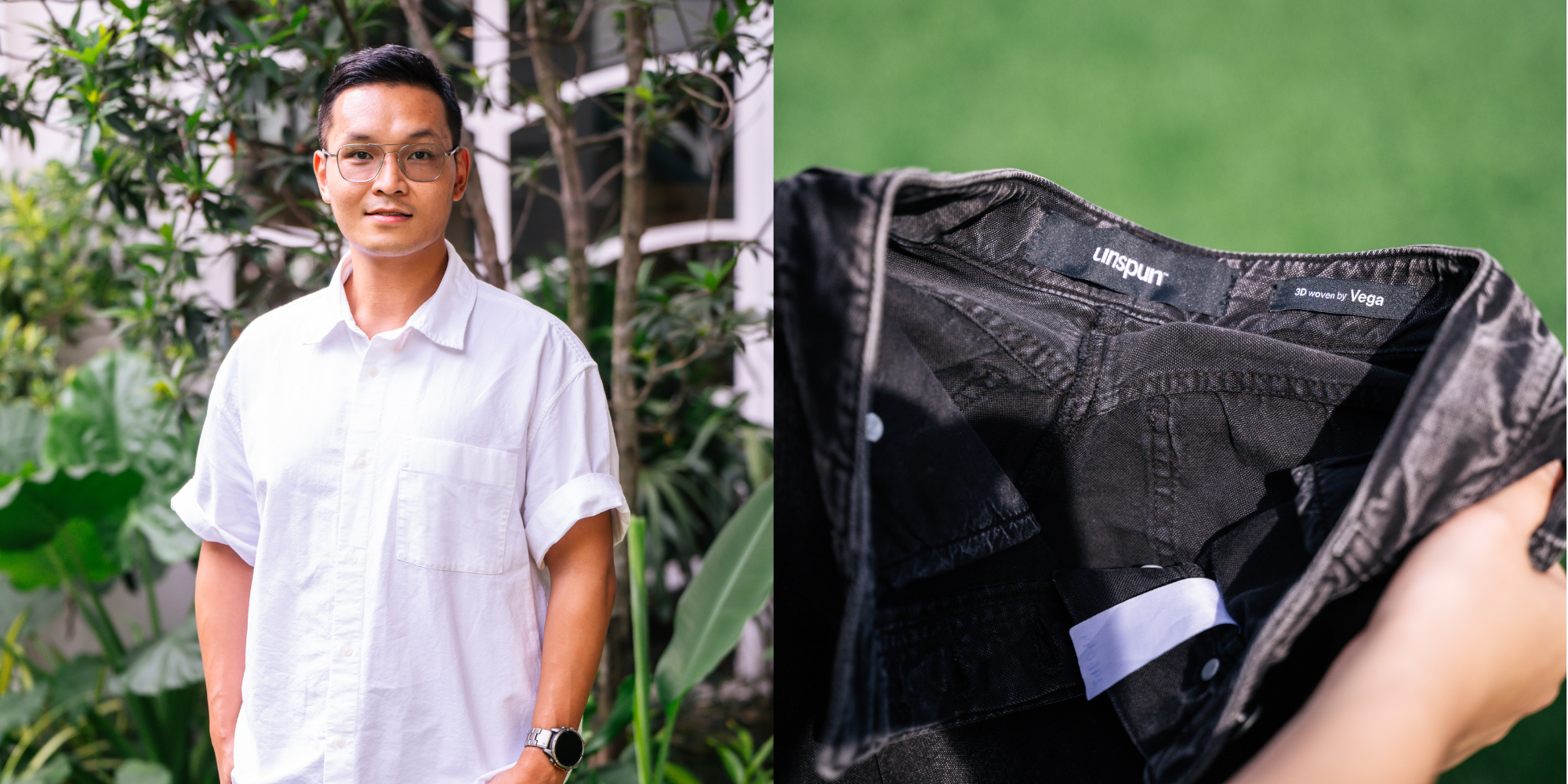
Walden Lam, Co-Founder, and a pair of jeans made by the Vega 3D-weaving machine.
For Unspun, sustainability begins before a single garment is made. The California-based company, co-founded by Walden Lam, is pioneering Vega — a 3D weaving and automated garment assembly technology that transforms yarn directly into finished clothing. By eliminating traditional cut-and-sew steps, Vega drastically reduces material waste, production time, and excess inventory.
The technology enables on-demand, localised manufacturing, making it possible for brands to align production with consumption habits — a radical shift from fashion’s decades-old model of mass production.
“What we are trying to solve is the inventory waste problem of the fashion industry,” said Lam. “Our 3D weaving technology automates apparel manufacturing, bringing production closer to consumption and reducing the massive amount of excess inventory that ends up landfilled each year.”
As Unspun works to localise a traditionally global supply chain, it sees a major opportunity to scale its automation by partnering with manufacturers across the region — especially at a time when geopolitical shifts are prompting brands to rethink where production happens.
By merging robotics, data, and design, Unspun is redefining how apparel is created, proving that the future of fashion lies not in making more, but in making smarter.
Through the Amplifier programme, Unspun hopes to better understand Asia’s investor and manufacturing landscape and forge partnerships to scale its automation platform regionally.
From fibre to future
Supported by SHEIN as impact innovation partner and the Singapore Fashion Council as strategic partner, the Textiles track epitomises the Amplifier’s vision of bridging global innovation with Asia’s growing sustainability markets. Together, these mentees address the four pillars of circular textile innovation: minimising pre-consumer textile impact, transforming post-consumer textile impact, keeping apparel in circulation, and innovating with alternative and sustainable materials.
As they embark on their year-long mentorship journey, their collective work signals a future where impact and industry progress are woven together — thread by thread, solution by solution.
Stay tuned for more stories from the Amplifier 2025, spotlighting innovators from the Tourism and Employment tracks who are reimagining how business can be a force for good. Together, they reflect a growing movement to catalyse scalable, Asia-led solutions for a more inclusive and sustainable future.
🔗 Learn more about the Amplifier programme.
💡 Follow PAA and CIIP on LinkedIn for more updates and opportunities to collaborate.






.tmb-.png?Culture=en&sfvrsn=7fea9931_1)

.tmb-.gif?Culture=en&sfvrsn=e13997ec_1)



.tmb-.gif?Culture=en&sfvrsn=3f4b1163_1)








.tmb-.gif?Culture=en&sfvrsn=b5ece239_1)
.tmb-.gif?Culture=en&sfvrsn=6fb3b6df_1)


.tmb-.jpg?Culture=en&sfvrsn=fedc60fc_1)